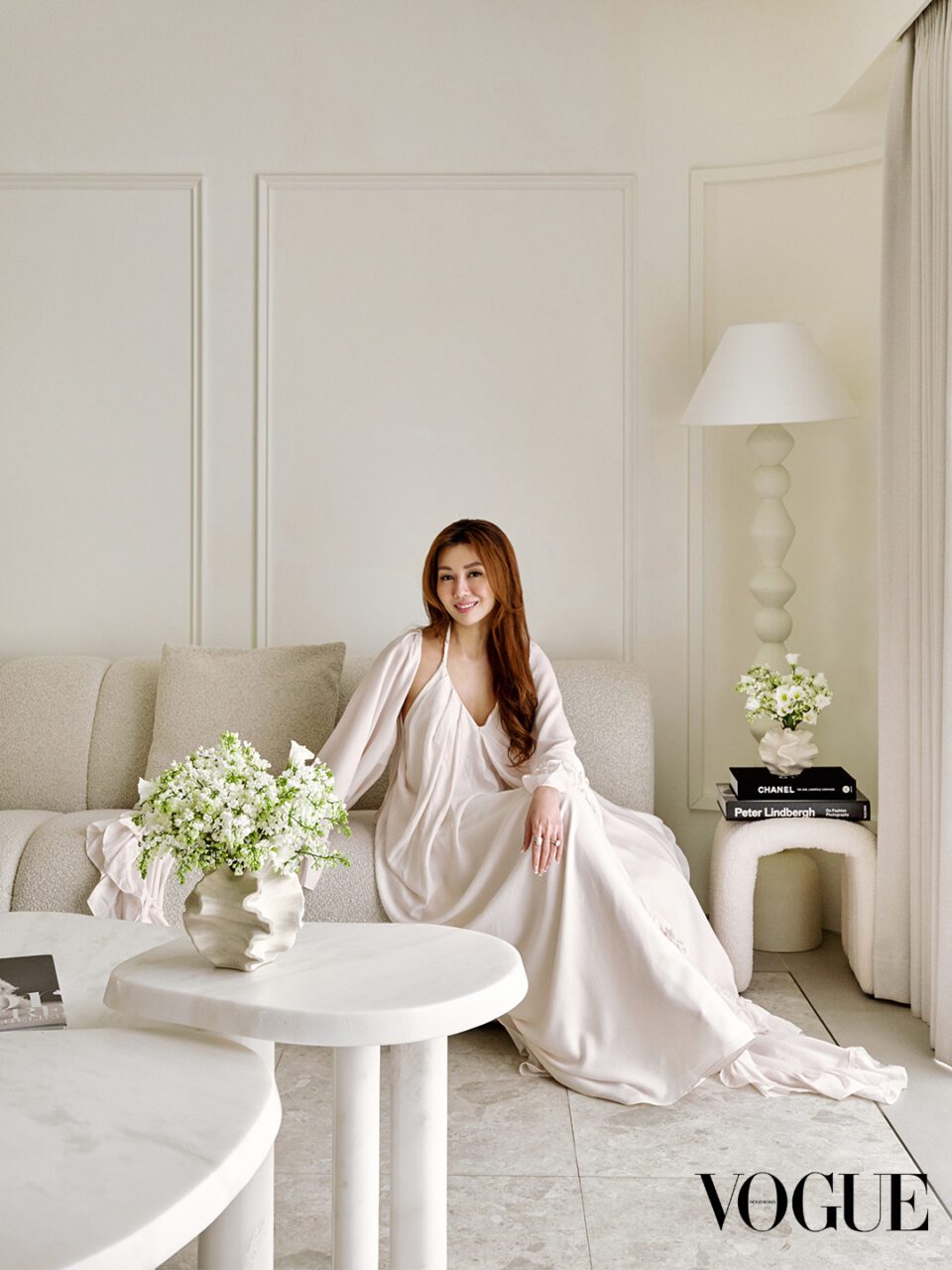


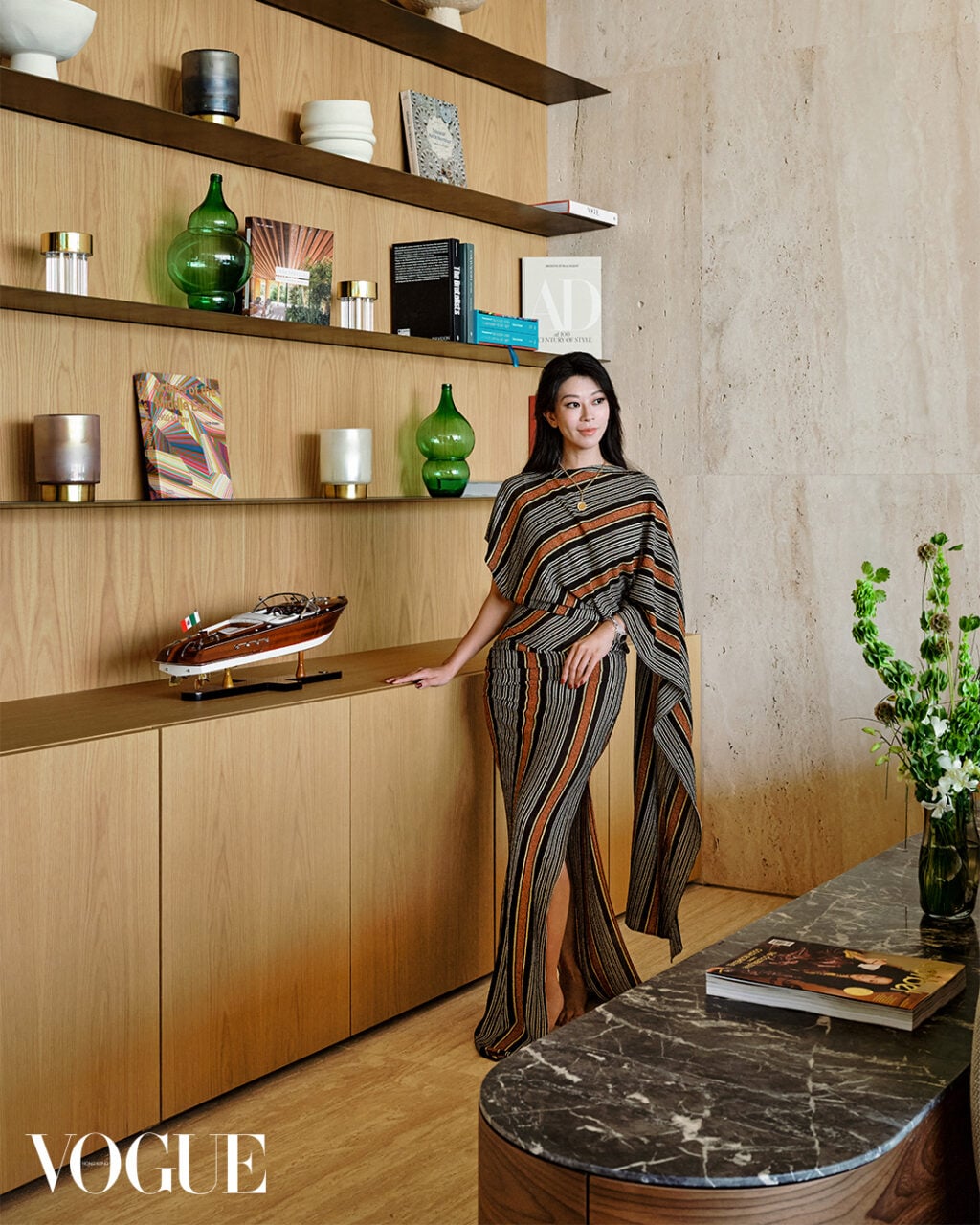
When Christy Liang first stood on the empty stretch of sand that would become her Dubai home, the emirate’s luxury property market was still more promise than proof. Over a decade ago, people still asked her family, “Why Dubai?”
Today, their answer stands elegantly on one of the city’s most exclusive stretches of coastline — a villa within Sea Mirror, an intimate collection of just eighteen homes where the Arabian Gulf’s turquoise waters meet Dubai’s ambitious skyline. What began as an early bet on an emerging market has evolved into something far more profound: a home that bridges continents and cultures, where three generations now gather each Chinese New Year to watch the sun melt into Gulf waters.


Their villa is a result of a remarkable collaboration between some of today’s most visionary design minds. Brazilian firm Jacobsen Studio shaped the architecture, while Milan-based Spanish architect and interior designer Patricia Urquiola brought her distinctive touch to the interiors. The result is what Liang describes as “a quiet dialogue between Brazilian modernism and the landscape of the Gulf.”
The architectural vision, led by Paulo Jacobsen, Bernardo Jacobsen and Edgar Murata from Jacobsen Studio, draws unexpected parallels between Brazilian and Arabic cultures. Sharp lines meet wide volumes, while bare concrete, slatted wood, and full-height glass create a composition that feels “both grounded and weightless.” The thoughtful use of sculptured planes and oxidised copper brise-soleils transforms the intense Dubai sun into dancing patterns across the walls, turning light itself into a design element.
When asked what she hopes first-time visitors experience upon entering her home, Liang’s response is immediate: “I hope they feel a sense of release. The entry opens toward water and light, and the first instinct most guests have is to exhale.” This reaction speaks to what Urquiola calls “absolute continuity” between interior and exterior, a philosophy that ensures no boundary exists between the home’s inner sanctum and the landscape beyond, creating a seamless flow that defines the entire living experience.
The home’s design responds intelligently to Dubai’s sunlight, which is, in Liang’s words, “extraordinary but unforgiving.” She continues, ”Every material had to be chosen for how it would behave at noon and at dusk. We zoned the home around that rhythm: the more active spaces facing the gentler morning light, and the living areas oriented toward the long, golden afternoons.” Jacobsen’s iconic slim roof eaves provide shelter while maintaining openness, and custom-designed slatted panels follow the sun’s orientation for both natural light and privacy.

When asked what she hopes first-time visitors experience upon entering her home, Liang’s response is immediate: “I hope they feel a sense of release. The entry opens toward water and light, and the first instinct most guests have is to exhale.” This reaction speaks to what Urquiola calls “absolute continuity” between interior and exterior, a philosophy that ensures no boundary exists between the home’s inner sanctum and the landscape beyond, creating a seamless flow that defines the entire living experience.
The home’s design responds intelligently to Dubai’s sunlight, which is, in Liang’s words, “extraordinary but unforgiving.” She continues, ”Every material had to be chosen for how it would behave at noon and at dusk. We zoned the home around that rhythm: the more active spaces facing the gentler morning light, and the living areas oriented toward the long, golden afternoons.” Arquitetura’s iconic slim roof eaves provide shelter while maintaining openness, and custom-designed slatted panels follow the sun’s orientation for both natural light and privacy.


Personal touches layer meaning throughout the space. Objects from Hong Kong, ceramics collected during family trips, and art marking significant life moments create what Liang calls the “most personal layer” of their home. “None of it is precious in the museum sense, but each object carries a story,” she reflects.

The home also caters to the family’s active lifestyle – both Liang and her husband grew up being swim team captains in California and Hong Kong, respectively – with a lower level featuring a gym, steam room, sauna, and wine cellar. An elevator connecting all four floors serves both practical needs and has become part of the children’s domain, where “hide and seek in this house is a serious affair.”

The heart of family life beats strongest in the kitchen, which opens directly onto the outdoor pool with the ocean just beyond. “The boundary between cooking and the water beyond essentially dissolves,” Liang explains. “You can be at the stove and still feel like you’re outside.” It’s here where Liang indulges in her love for cooking, dreaming up meals for the family, while the children swim and her husband “drifts in and out”—a space that encapsulates “the most honest version of [her] family life.”

During their first Chinese New Year celebration there, three generations gathered to watch the sunset over the water. “It was the moment the house stopped being a project and became a home,” Liang recalls. The family has committed to returning every Chinese New Year, establishing a tradition that roots them in this place. “A home, to me, is the place where the people you love feel most at ease.” Their Dubai villa embodies this philosophy, designed “to hold life rather than display it.”


Just as this house has become home through the people who fill it, so too has Dubai. Despite current uncertainties about the region’s future, the Liangs’ faith in the city remains unwavering. “We believed in the resilience of this city back then, and we believe in it just as much now,” Liang affirms. “Because at the end of the day, it’s the people who make a city. Beyond the skyline and the infrastructure, what truly captivates me is the warmth of the people. Middle Eastern hospitality is something you have to experience to understand—the way a guest is welcomed, the care taken in small gestures. That warmth is woven into the fabric of the city, and it’s part of why Dubai feels so much like home.”
Photography: Natalie Dunn
Text: Kaitlyn Lai
Makeup Artist: Vivi Ziwei Lu
Hair Stylist: Carlo Lucas De Guzman
Florals: Goshá
Editor
Kaitlyn LaiCredit
Photography: Natalie Dunn