


Robert Wun’s invitation arrived in a box so substantial it suggested couture had diversified into home furnishings. Beneath the magnetized lid, instead of the usual crop of branded ephemera—this season’s engraved pendants, and the mandatory fan in 40-degree Paris—sat a Skull Panda figurine: a winged, bulbous-headed creature complete with its own ID card and USB port.
The Skull Panda wasn’t a collectible gimmick so much as a clue. At a preview, Wun acknowledged that his work has long been labeled ‘dark,’ a description he decided to investigate rather than dismiss. “It’s like holding a mirror against my so-called dark side and seeing what’s on the other side,” he remarked. The answer wasn’t exactly sunshine. Wun detoured into childhood, spinning a fairytale universe entirely his own, where Charles Perrault and the Brothers Grimm would find a USB port far more bewildering than any wicked witch.
His touchstone was the work of Japanese animator Hayao Miyazaki, whose films wrap profound moral questions inside worlds that appear deceptively childlike. Wun was drawn to that contradiction. Stories that look as though they’re made for children, he said, often carry the most enduring truths about humanity, fear, violence, and hope.
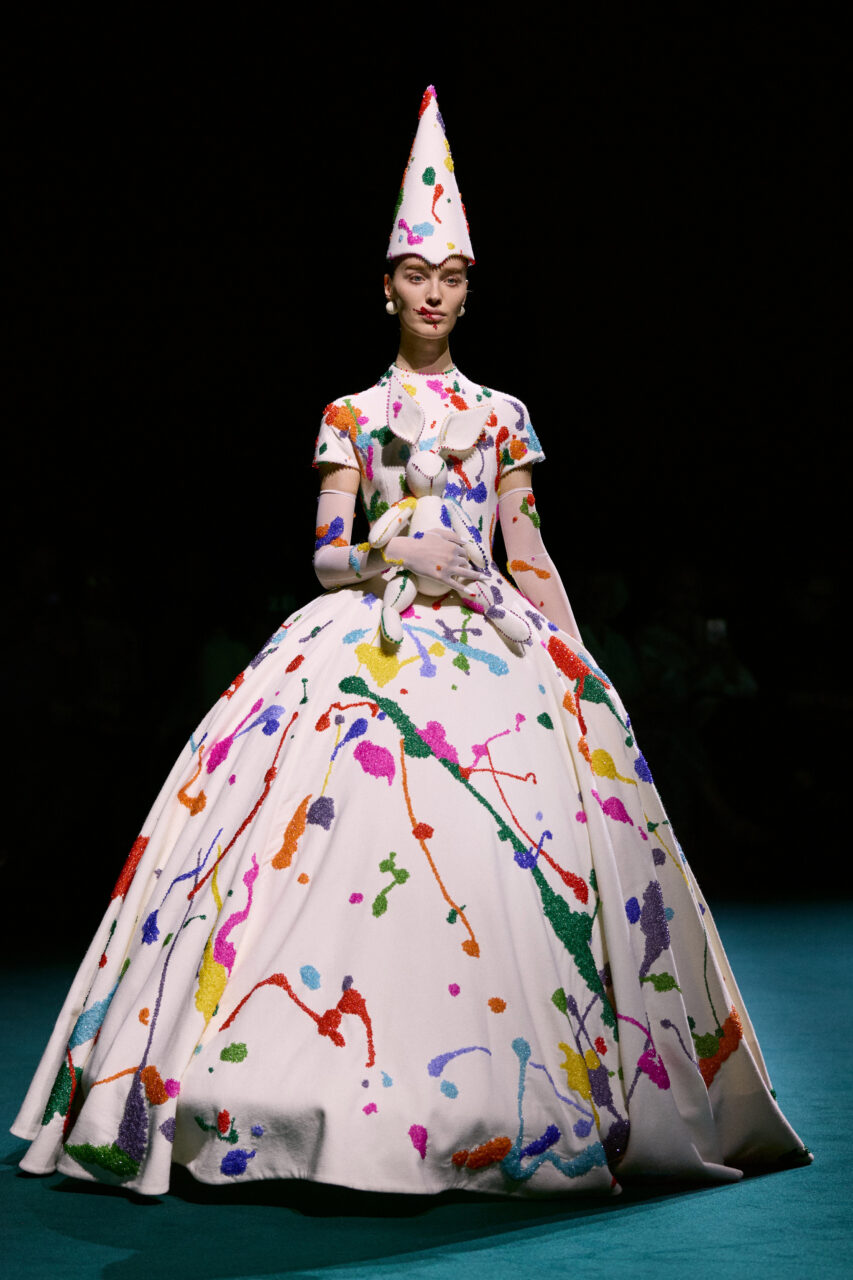
Wun’s imagination has long outgrown conventional show venues, making the Dôme de Paris a fitting stage for his supersized fantasies. An inflatable Skull Panda loomed over the runway, while a soundtrack closer to a fever dream than a lullaby introduced a procession charting the uneasy passage from childhood to adulthood. The opening look was a monumental gown embroidered with colorful doodles as if drawn by a child, complete with its own matching stuffed animal. What followed was a sort of slightly unhinged school reunion for fairytale characters.
Cinderella came back to retrieve the glittering shoe she’d inexplicably left behind; the Big Bad Wolf prowled in a sharply sculpted gray suit with cartoonishly swollen shoulders; Red Riding Hood wandered through Wun’s world of saturated primaries and heroic proportions, alongside Snow White swathed in a draped cobalt confection suspended from two doves frozen mid-flight. Then the mood curdled, as childhood invariably does. Maleficent appeared as evil incarnate in a gown assembled from glossy black garbage bags. An astronaut drifted by wearing an entire dark galaxy of crystals, while Jack Skellington’s anatomy was translated into the chalk stripes of a tailored suit, as though Savile Row had given Halloween an internship. The emotional climax belonged to an immense white horned creature clutching an equally horned teddy bear. “It’s Bambi’s mother,” explained the designer. “The saddest character in all fairytales.”
The show closed with a monumental black dress crowned by a chaotic cloud of customized balloons, a visual metaphor for the inner child that refuses to be tied down. Or, perhaps, the only balloons in Paris this week that weren’t filled with hot air. Beneath the fantasy, however, lay a more sober proposition. “The intention is to be inspired by the un-serious, but to create seriously,” remarked Wun. Against a backdrop of wars, heatwaves, and a world that feels increasingly unmoored, he argued that fashion’s role extends beyond spectacle: “Couture may not offer solutions, but it can keep wonder alive, a precious resource when reality seems determined to extinguish it.”
Editor
Tiziana CardiniCredit
Lead Image: Gorunway