

You’re scrolling through the handbag section online when a shoulder bag catches your eye. Intrigued, you click into it to find a beautifully crisp 3D rendering. It spins around with your cursor, showing off every angle possible. You zoom in to check the seams and folds. Then, you upload the product onto your digital avatar. It’s not bad, but you’re not sure about the colour. As you scroll through the store’s page, you see similar options in various materials, shades, and finishes.
Overwhelmed, you decide to sleep on it. But the bag follows you everywhere: influencers with shoulder bags flood your Instagram, alongside YouTube campaigns and LinkedIn ads for the brand’s next collection. . You even get an exclusive invite from the brand to view their newest collection—a reward for your demonstrated loyalty through your purchases in the Metaverse. Surely, it’s a sign. Fate, perhaps. You must have the bag.
Well, no. It’s not fate at all, but genius tech and marketing that is changing the omnichannel user experience in luxury retail.
In the store, you hardly have to wait as sales associates move swiftly in and out of the store rooms. Even when you do, an interactive game featuring the brand’s products keeps you entertained. You become entranced by a ring you see displayed in the game, and just as you mentally note to ask to have a look at it, your sales associate appears with the actual ring on a velvet tray.
We have other similar options in our stores across the globe,” they tell you, directing you over to their augmented reality try-on system. You place your hand under a camera and the screen next to it shows your finger overlaid with a majestic gold band.
Still fixed on the original ring from the game, you take out your phone to scan the micro-engravings on the inside of it. A digital passport appears on your screen, giving you a detailed breakdown of the product, from its stones and material origins, to its history, and certificate of authenticity.
This is the future of luxury retail. Convenient, personalised, and efficient.

Breaking Down the Technology
Luxury retail brands have been working with tech companies for a long time on different facets of their operations. With the recent VivaTech conference in Paris, LVMH has positioned itself as a pioneer in the intersection of technology and fashion. Their dedicated space, Dreamscapes, featured the newest technologies adopted by their brands.
Dior is working with startup Kahoona to provide a more engaging and personalised shopping experience online. Kahoona’s technology identifies and profiles high-value customers in real time, tailoring the website experience to their preferences and increasing the likelihood of converting website browsers into buyers. As a consumer, this means an efficient shopping experience that is reflective of your interests.
Besides Kahoona, Dior has also partnered with Scandit to optimise warehouse operations. Scandit’s augmented reality (AR) technology accelerates inventory management, reduces manpower requirements, minimises customer wait times, and ensures accurate tracking of stock.
Meanwhile, at Rimowa, the hyper-realistic 3D renderings seen on the website are the work of Solaya AI, a company that scans products and uses AI to create high-quality visual content, including photos and videos. . The same rendering technology is used by Apple to promote their products. Other companies like RIGSTER and OMI operate in this space, helping brands bring their products to life online through similar 3D renderings.
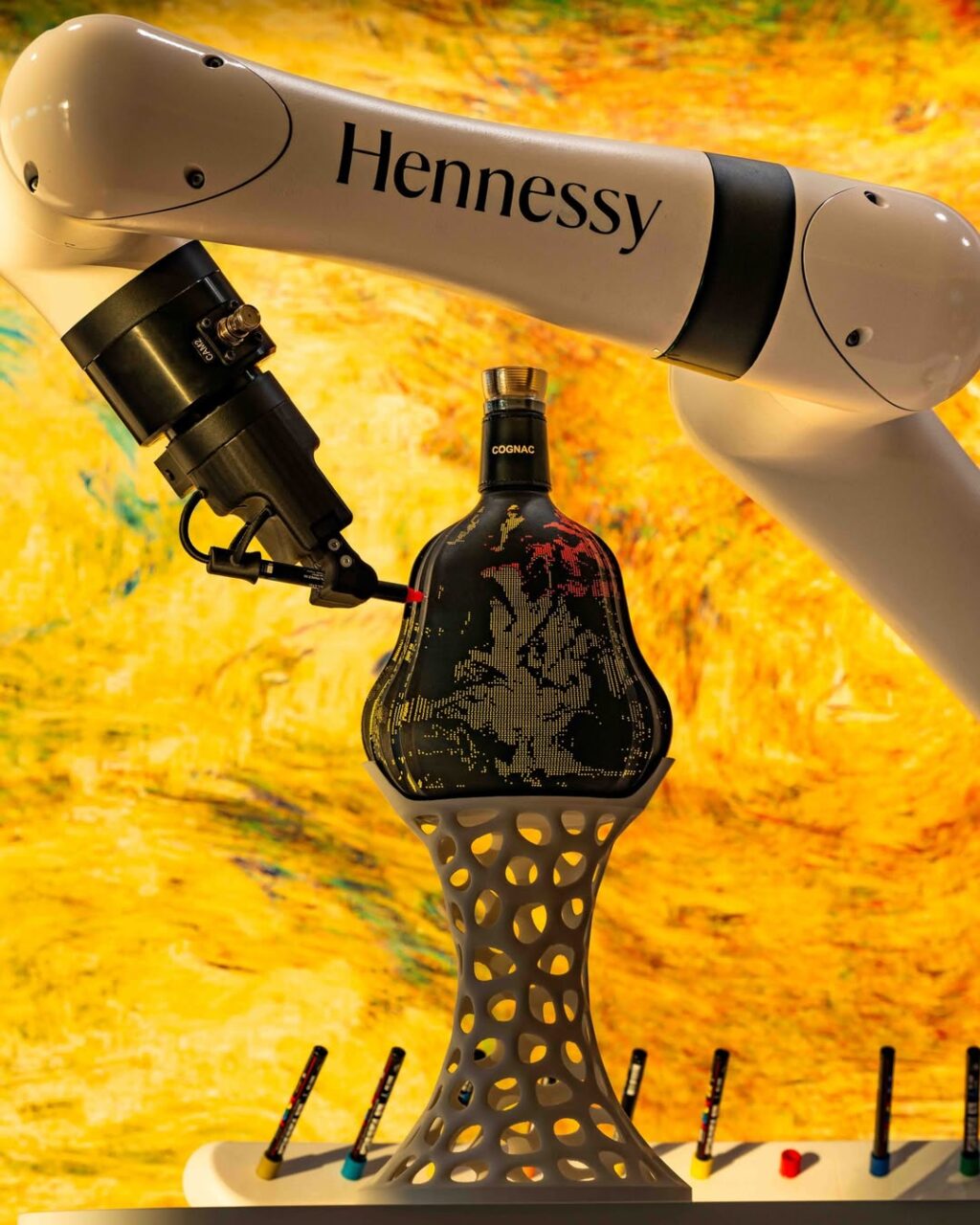
Hennessy X.O. has taken personalisation to the next level in their collaboration with OKCC, a Seoul-based creative agency. In partnership with generative artist Florian Zumbrunn, they created bespoke decanters using a robot arm and algorithmic data. Each decanter has a truly unique design made of 32,000 micro-dots and 15 colours.
Virtual try-ons have also gained traction, particularly among eyewear brands like Ray-Ban, Oakley, and Warby Parker. A standout player in this field is Doji, an app that allows users to create a digital avatar to try on not just the newest pair of sunnies, but clothes and accessories. Their small New York-based team is made up of minds from Apple, Meta, and other large tech conglomerates. The app is currently invite-only and not yet available in Hong Kong.
Blockchain, the Metaverse, and AR
Luxury brands have also embraced more unconventional means to engage with newer audiences in the last few years, namely NFTs and virtual experiences. Dolce & Gabbana’s #DG Family NFT community, launched in 2021, offers digital collections wearable in the Metaverse, along with exclusive access to physical and virtual events. Similarly, Gucci sold its first NFT through Christie’s the same year, using digital assets to cultivate brand loyalty and exclusivity.
Blockchain technology, the tech behind NFTs, can also ensure the authenticity of a product and increase production transparency — values that resonate withGen Z buyers who prioritise ethical consumerism. With this in mind, LVMH, Richemont, Prada Group, and OTB founded the Aura Blockchain Consortium in April 2021, providing digital passports to buyers that trace every product’s origin and production journey. Since then, they have been joined by over 50 members. Tod’s Gommino shoes and Maison Margiela’s Tabi shoes are examples of products that offer NFC tags with this information.

In terms of virtual experiences, brands like Givenchy, Gucci, and Burberry have invested a significant amount into Roblox, taking advantage of its wide-reaching platform for creative exchange. The Gang, a Stockholm-based developer studio, has played a key role in building most of these worlds. Most recently, they worked with Paris Saint-Germain Football Club to create their Roblox world where users can explore athletic culture and luxury fashion.
These virtual spaces not only attract younger consumers but also generate significant revenue through virtual products, which often sell for more than their physical counterparts. Additionally, they provide access to luxury brands for those who might not otherwise experience them.
Outside of these online spaces, brands have also adopted technologies to improve in-store customer experience. Loewe and Sephora have worked with Paris-based creative digital studio Cosmic Shelter to create in-store entertainment through the gamification of their products. This transforms waiting time for customers into something engaging and fresh, while enabling brands to understand what products are more appealing for customers. Cosmic Shelter has also worked with Fendi, Cartier, Zadig & Voltaire, and more to create virtual experiences and even launch virtual collections.
Augmented reality try-on has also been used by Cartier through their very own Looking Glass. They worked with software developers Jolibrain and Blue Trail Developers to bring the technology to life in their retail innovation lab in Brooklyn in 2021. The lamp-like AR camera gives customers the ability to try one-of-a-kind Cartier pieces that might not always be available in-store. This technology is incredibly practical for brands like Cartier that cannot risk shipping their luxury pieces around the world for clients to try on. Last year, Cartier also worked with Snapchat to allow AR try-ons for their Trinity Ring. This is luxury’s attempt to tap into the Gen-Z market with the majority of Snapchat’s users ranging from 13- to 34-year olds. The idea is to create desirability before they can even afford it.
Besides try-ons, Bvlgari has teamed up with Dev4Side to create a digital passport system to ensure the authenticity of their products. This is slightly different from what the Aura Blockchain Consortium has done because they have moved beyond the digital space of NFCs. The process uses optical character recognition and AI machine learning to identify physical micro-engravings on each piece. This authenticates and accesses all the information about each piece.
This is just beginning
These innovations have not been without skepticism. Most people are rightfully concerned about the privacy and protection of their data, which is a constant problem the industry will have to deal with. Personalised experiences require brands to collect data about their customers. While brands have worked to ensure the protection of the data they collect, the risks are always present. As customers, we have the right to decide what data is collected and how it is used, bearing in mind though that the less you provide, the more difficult it is for companies to give you the most optimal experiences. There have also been concerns over the use of blockchain technology given the volatility of the NFT market and cryptocurrency. This has led brands away from Sandbox experiences and speculative NFTs in the past few years, and instead choosing to invest in Roblox or Meta, which is not as much at the mercy of the crypto ecosystem.
The fashion industry is continually taking risks, learning and evolving when it comes to technology. With the new R:Tech Hub is Lisbon launched by Richemont at the end of May this year, we can only expect the innovations to continue rolling out. And as consumers, that means more efficient, engaging, and personalised experiences await us.
Editor
Natasha YaoCredit
Lead Image: @okcc_agency via Instagram